

Hola a todos, hoy os dejo una serie de ejercicios sobre la base de datos de pokemon en mysql.
Todos los ejercicios que proponemos están resueltos en este mismo post, intenta hacerlo por ti mismo y si te quedas atascado puedes mirar la solución. Recuerda, que no tiene por que estar igual tu solución con la del post, el objetivo es que aprendas no que me copies la solución.
Aquí te dejo la base de datos de pokemon que debes importar.
Aquí te dejo un manual sobre como importar la base de datos en MySQL.
Importar una base de datos o esquema en MySQL desde MySQL Workbench
Os dejo el modelo Entidad – Relación de la base de datos:

Al final de cada ejercicio, os indico el resultado esperado. En caso de ser muchos datos, indico el numero de filas devueltas.
1. Mostrar el nombre de todos los pokemon.
|
1 2 |
select nombre from pokemon; |
Debe devolver 151 registros.
2. mostrar los pokemon que pesen menos de 10k.
|
1 2 3 |
select nombre from pokemon where peso <=10; |

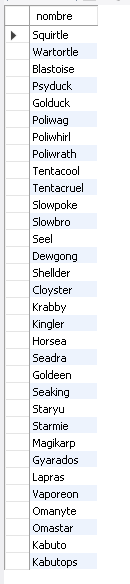
3. mostrar los pokemon de tipo agua.
|
1 2 3 4 5 6 7 8 9 10 11 12 13 14 15 |
-- sin subconsulta select p.nombre from pokemon p, pokemon_tipo pt, tipo t where p.numero_pokedex = pt.numero_pokedex and pt.id_tipo=t.id_tipo and lower(t.nombre) = 'agua'; -- con subconsulta select p.nombre from pokemon p, pokemon_tipo pt where p.numero_pokedex = pt.numero_pokedex and pt.id_tipo = (select id_tipo from tipo t where lower(t.nombre) = 'agua'); |
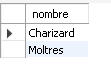
4. Mostrar los pokemon que son de tipo fuego y volador.
|
1 2 3 4 5 6 7 8 |
select nombre from pokemon where numero_pokedex in (select numero_pokedex from pokemon_tipo pt, tipo t where pt.id_tipo=t.id_tipo and lower(t.nombre)='fuego') and numero_pokedex in (select numero_pokedex from pokemon_tipo pt, tipo t where pt.id_tipo=t.id_tipo and lower(t.nombre)='volador'); |
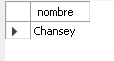
5. mostrar los pokemon con una estadística base de ps mayor que 200.
|
1 2 3 4 |
select p.nombre from pokemon p, estadisticas_base est where p.numero_pokedex=est.numero_pokedex and est.ps>=200; |
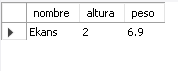
6. mostrar los datos(nombre, peso, altura) de la prevolucion de Arbok.
|
1 2 3 4 5 6 |
select p.nombre, p.altura, p.peso from pokemon p, evoluciona_de ev where p.numero_pokedex = ev.pokemon_origen and ev.pokemon_evolucionado = (select numero_pokedex from pokemon where LOWER(nombre) = 'arbok') |
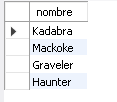
7. Mostrar aquellos pokemon que evolucionan por intercambio.
|
1 2 3 4 5 6 7 |
select p.nombre from pokemon p, pokemon_forma_evolucion pfe, forma_evolucion fe, tipo_evolucion te where p.numero_pokedex = pfe.numero_pokedex and pfe.id_forma_evolucion = fe.id_forma_evolucion and fe.tipo_evolucion = te.id_tipo_evolucion and lower(te.tipo_evolucion) = 'intercambio'; |
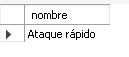
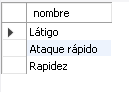
8. Mostrar el nombre del movimiento con mas prioridad.
|
1 2 3 4 |
select nombre from movimiento mov where prioridad = (select max(prioridad) from movimiento) |
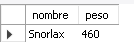
9. Mostrar el pokemon mas pesado.
|
1 2 3 4 |
select nombre, peso from pokemon where peso = (select max(peso) from pokemon) |
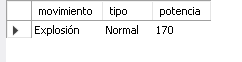
10. Mostrar el nombre y tipo del ataque con mas potencia.
|
1 2 3 4 5 |
select m.nombre as movimiento,t.nombre as tipo, m.potencia from movimiento m, tipo t where m.id_tipo = t.id_tipo and m.potencia = (select max(potencia) from movimiento) |
11. Mostrar el numero de movimientos de cada tipo.
|
1 2 3 4 |
select t.nombre as tipo, count(*) as num_mov from tipo t, movimiento m where m.id_tipo = t.id_tipo group by t.nombre; |
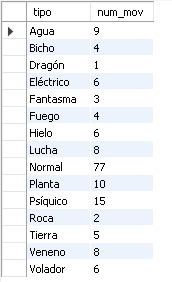
12. Mostrar todos los movimientos que puedan envenenar.
|
1 2 3 4 |
select m.nombre, mes.probabilidad from movimiento m, movimiento_efecto_secundario mes, efecto_secundario es where m.id_movimiento = mes.id_movimiento and mes.id_efecto_secundario = es.id_efecto_secundario and lower(es.efecto_secundario) like '%envenena%' |
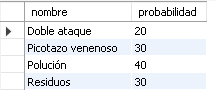
13. Mostrar todos los movimientos que aprende pikachu.
|
1 2 3 4 |
select distinct m.nombre from movimiento m, pokemon p, pokemon_movimiento_forma pmf where p.numero_pokedex = pmf.numero_pokedex and pmf.id_movimiento = m.id_movimiento and lower(p.nombre) = 'pikachu'; |
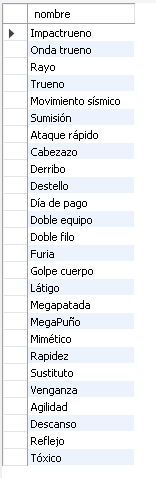
14. Mostrar todos los movimientos que aprende pikachu por MT.
|
1 2 3 4 5 6 7 8 |
select distinct m.nombre from movimiento m, pokemon p, pokemon_movimiento_forma pmf, forma_aprendizaje fa, tipo_forma_aprendizaje tfa where p.numero_pokedex = pmf.numero_pokedex and pmf.id_movimiento = m.id_movimiento and pmf.id_forma_aprendizaje = fa.id_forma_aprendizaje and fa.id_tipo_aprendizaje = tfa.id_tipo_aprendizaje and lower(tfa.tipo_aprendizaje) = 'mt' and lower(p.nombre) = 'pikachu'; |
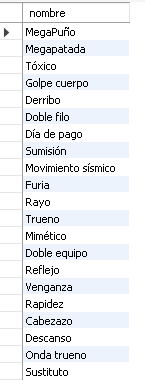
15. Mostrar todos los movimientos de tipo normal que aprende pikachu por nivel.
|
1 2 3 4 5 6 7 8 9 10 11 12 13 14 |
select distinct m.nombre from movimiento m, pokemon p, pokemon_movimiento_forma pmf, forma_aprendizaje fa, tipo_forma_aprendizaje tfa, tipo t where p.numero_pokedex = pmf.numero_pokedex and pmf.id_movimiento = m.id_movimiento and pmf.id_forma_aprendizaje = fa.id_forma_aprendizaje and fa.id_tipo_aprendizaje = tfa.id_tipo_aprendizaje and m.id_tipo = t.id_tipo and lower(t.nombre) = 'normal' and lower(tfa.tipo_aprendizaje) = 'nivel' and lower(p.nombre) = 'pikachu'; |
16. Mostrar todos los pokemon que evolucionan por piedra. Hacer una vista de ello.
|
1 2 3 4 5 6 7 8 9 10 |
create or replace view pokemon_evolucion_piedra as select distinct p.numero_pokedex, p.nombre from pokemon p, pokemon_forma_evolucion pfe, forma_evolucion fe, tipo_evolucion te where p.numero_pokedex = pfe.numero_pokedex and pfe.id_forma_evolucion = fe.id_forma_evolucion and fe.tipo_evolucion = te.id_tipo_evolucion and lower(te.tipo_evolucion) = 'piedra'; select * from pokemon_evolucion_piedra; |
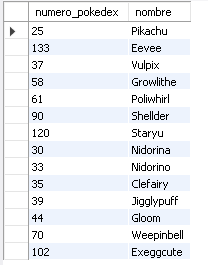
17. Mostrar todos los pokemon que no pueden evolucionar. Hacer una vista de ello.
|
1 2 3 4 5 6 7 8 9 10 11 12 13 |
create or replace view pokemon_no_evolucionan as select p.numero_pokedex, p.nombre from pokemon p, evoluciona_de ev where p.numero_pokedex = ev.pokemon_evolucionado and not exists (select pokemon_origen from evoluciona_de where pokemon_origen = p.numero_pokedex) union select p.numero_pokedex, p.nombre from pokemon p where not exists (select * from evoluciona_de where pokemon_origen = p.numero_pokedex or pokemon_evolucionado = p.numero_pokedex); select * from pokemon_no_evolucionan; |
Debe devolver 80 registros.
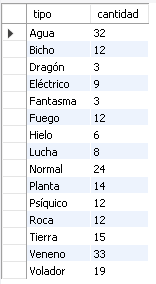
18. Mostrar la cantidad de los pokemon de cada tipo. Hacer una vista de ello.
|
1 2 3 4 5 6 7 8 |
create or replace view cantidad_tipo_pokemon as select t.nombre as tipo, count(*) as cantidad from pokemon p, pokemon_tipo pt, tipo t where p.numero_pokedex = pt.numero_pokedex and pt.id_tipo = t.id_tipo group by t.nombre; select * from cantidad_tipo_pokemon; |
Os dejo una serie de videos donde realizo estas consultas:
Espero que os sea de ayuda.


bro, estan buenos los ejericios. gracias por compartir